
You Should Read This #1: The Dispossessed by Ursula K. Le Guin
"I never thought before," said Tirin unruffled, "of the fact that there are people sitting on a hill up there, on Urras, looking at Anarres, at us, and saying, 'Look, there's the Moon.' Our earth is their Moon; our Moon is their earth."
"Where, then, is Truth?" declaimed Bedap, and yawned.
"In the hill one happens to be sitting on," said Tirin.
- The Dispossessed, Chapter 2, Ursula K. Le Guin
I read The Dispossessed while I was on a trip to temples deep in the mountains of Japan. I finished it in the car, while my wife and her sister were singing some Japanese pop songs in the front seat.
In the backseat, I was near tears.
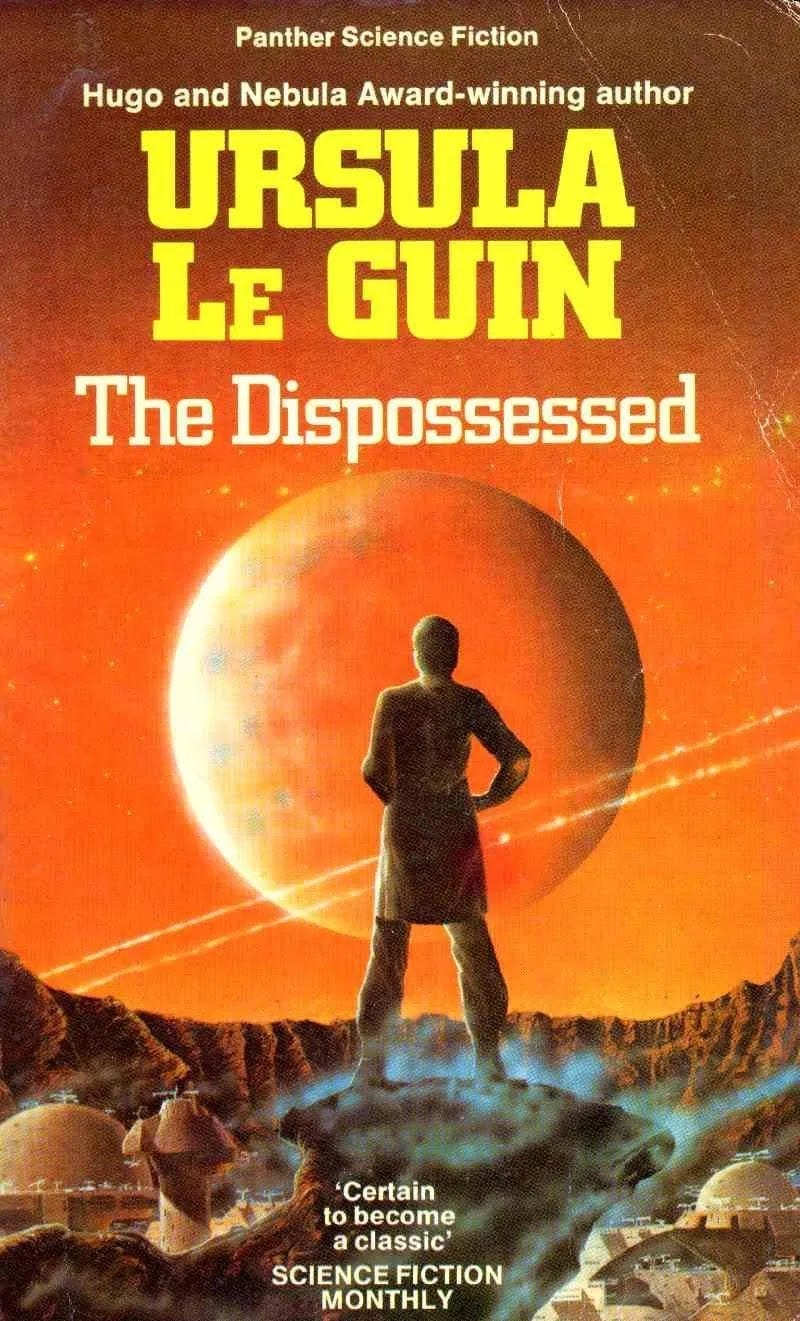
Originally published in 1974, The Dispossessed is an anarchist utopian novel written by one of the greatest speculative fiction writers of the modern era Ursula K. Le Guin. The book follows Shevek, a physicist on the anarchist planet of Anarres. He has traveled to their sister planet of Urras in order to share his research and try to build a better relationship with the society that his own once broke away from. The novel is told in alternating chapters of Shevek's past and his present as he navigates life on Urras.
The main plot follows Shevek as he tries to further his research of a mathematical theory that could make faster-than-light communication possible. All the while, he is navigating the culture of Urras and trying to reconcile his anarchist beliefs with that of his hosts' planet.
There is probably not much about this book that hasn't been said already, not much I can add but my own personal experience with it. Originally, the book was often subtitled with the phrase, 'An Ambiguous Utopia', and this ambiguity is a theme carried throughout the book, as one can see from the quote above.
But how, you might ask, does it seem to make sense that I was reading this book while on a type of pilgrimage to Buddhist temples, one my wife makes every year with her family. How does that and anarchy mix?
Well, Le Guin's anarchy is peaceful. It is defined more by what it is not than what it is. It's a book that can challenge out notion and beliefs in systems, and make us think about many of the systems we take for granted.
To be fair, I am someone who has always been fascinated with anarchy. I don't condone violence, and there are many forms of anarchy which are not violent, and it led me to consider the various ways in which anarchy may be applied. Sometimes, I like to have small thought experiments where I will come up with a statement (which I may or may not believe to varying degrees) and then challenge myself to test them through deeper thinking or reading. I came up with one a while ago, perhaps nearly two years ago now, where I thought: "Anarchy is the only true moral form of society that exists."
Quite a bold claim, but generally, these thoughts never leave my head. My sort of caveat to this statement was: "While this may be true, I don't believe that it's achievable."
So it was quite to my delight that I, nearly two years later, learned that Le Guin had essentially been testing the same theory in The Dispossessed. Could peaceful anarchy work? Could it lead to a just society with no hierarchy, collusion, cyberpunk levels of capitalism, forced ideology etc.? I don't think it's a spoiler (based on the subtitle of the book) to say that Le Quin never quite reached a conclusion. The book didn't give me answers, but it made me think, and it's a book that lingers. It's a book that forces you to really see the systems around you, and it did, on more than one occasion, make me stop and ask, What are we doing? Why are the systems this way? Why do we just participate in them?
There is a pureness in the original concept of Le Guin's anarchy. A pureness that eventually becomes tainted by social pressures and collectivism, but it starts out as pure, a society based on mutual aid and trust, built upon the idea that lack of want will deter immoral actions.
As Le Guin writes in Chapter 8, "A child free from the guilt of ownership and the burden of economic competition will grow up with the will to do what needs doing and the capacity for joy in doing it. It is useless work that darkens the heart." Many of the characters throughout the book share this sentiment, but it is also one that is constantly challenged. Shevek's journey to Urras leads him to search more deeply into the truths of his own culture and the culture of others. While he finds many things quite appalling about the society on Urras, he also acknowledges their advancements and beauty, the things they were able to accomplish because of the concept of capital, paid labor, and hierarchy. Throughout the novel, we see Shevek's own individualism and his desire to study and stay with his family at odds with the larger needs of the group.
While the political ideas in the book are fascinating, the most heart-wrenching part that stands out in my mind was during the time of famine. Shevek and his wife were separated by work assignments, only for Shevek to rush home once he was finally able to see her again. Except Shevek came home to an empty room, his wife assigned to a different workplace, and they ended up not seeing each other for four years. Le Guin wrote with such clarity the moment that Shevek rushed home, bursting through the door to find an empty home and his wife gone, only a note left, saying she was reassigned and that she couldn't refuse, could she? They were in a famine, and she had to help.
The famine was a major part of the book, and raised the question that Le Guin also poses in Chapter 8: "It was easy to share when there was enough, even barely enough, to go around. But when there was not enough? Then force entered in; might making right; power, and its tool violence, and its most devoted ally, the averted eye." Le Guin's clarity in the way she views her anarchical experiment is the power of the novel. It never borders on fantasy or unrealistic harmony. She explores the psychology of how people would act in this situation. I think the novel believes in the inherent good of people, and I think the person who truly believes in peaceful anarchy would also have to trust in an inherent goodness. A goodness that is brought forth (or once again allowed to flourish) when the systems that grind us down are removed.
You could write research papers on the themes in The Dispossessed, and many have. The concept of 'the wall', anarchy vs. capitalism vs. socialism, collectivism and individualism, responsibility, family, gender dynamics—the list goes on. But all I hope to do with this article is to intrigue you to read this work if you have not already. For me it was interesting since I have no experience with any other Hainish Cycle books, and I have only ever read A Wizard of Earthsea by Le Guin. At first, I was a little embarrassed that I hadn't read her sooner, but now a part of me is glad. A beautiful, Penguin Galaxy edition of The Left Hand of Darkness sits waiting on my shelf, and one that I think 31 year-old me will appreciate much more now than I ever could have in the past.
I'll end with this. There is some speculation that the title of The Dispossessed comes from Fyodor Dostoyevsky's novel The Possessed, which in more recent years, is usually and more accurately translated as Demons. Dostoyevsky's novel is a largely scathing indictment of violent radicalism, and I think Le Guin's title is playing off the subtle religious imagery, and the recurring image of emptiness throughout the book.
Early on, Shevek remarks that he has brought almost nothing with him to Urras as the people on Anarres do not have possessions. He can own nothing in his own culture, merely just use things. For me, this idea of owning nothing is scary. I have a nice bookshelf full of books and if someone came to take them away, I would be quite upset. But then I began to wonder if our desire to own stems from fear. I want to own my books because I'm afraid they won't be published one day again. I don't like to buy ebooks because corporations could take them away with no notice or financial recompense. Same for music or movies or any other digital media. But in Shevek's society there are no corporations, no hierarchy. Not owning a book still means you can keep it at your house for a week or two and use it. You could still rent it from the library and share it with your friends. Things are tools and gifts and far from meaningless, they just don't belong to one person. When I thought of that, it seemed extremely freeing, and I realized that much of our modern ownership is merely anxiety. We feel the need to own because our society constantly takes from us.
For Shevek and his society, this is not true. They have nothing, and in that nothingness, there is purity. While the book argues that nearly any system can be corrupted, at its core the book is about the possessed and the dispossessed. The possessed are filled with things and demons, controlled and acted upon. But the dispossessed are truly free, and what an amazing thing it would be to achieve that exorcism.